When the hip-hop history books are written, The Jaz, aka Jaz-O will probably be remembered for introducing the world to arguably the greatest (and undisputed most financially successful) emcee of all time, Jay-Z. While he was Jay’s friend, mentor, and entry point into the game, many overlook that he also had a rap career of his own. Ironically, I was introduced to Jaz-O through Jay-Z when he joined Jay and Sauce Money on the classic Premo-produced mafioso posse joint, “Bring It On” from Reasonable Doubt. It would be a few years after “Bring It On” (thanks to Nas’ “Ether”) that I would discover Jaz-O had released a couple of albums and an EP on EMI Records, long before Reasonable Doubt existed: His 1991 EP, Ya Don’t Stop, 1990’s To Your Soul, and his 1989 debut album, Word To The Jaz.
The liner notes for WTTJ credit Jaz, Bryan “Chuck” New, and Pete “Q” Harris for the production. The album made very little noise, nationally and would come and go faster than a sixteen-year-old boy losing his virginity to a hooker in an alley. EMI would give Jaz a couple more chances with To Your Soul and Ya Don’t Stop, both yielding similar commercial results. Along with making a couple of cameos and producing a few tracks on Jay-Z’s nineties batch of albums, Jaz would also produce songs for the likes of Puff Daddy, Rakim, Queen Latifah, M.O.P., Gza, Rass Kass, and Group Home, just to name a few.
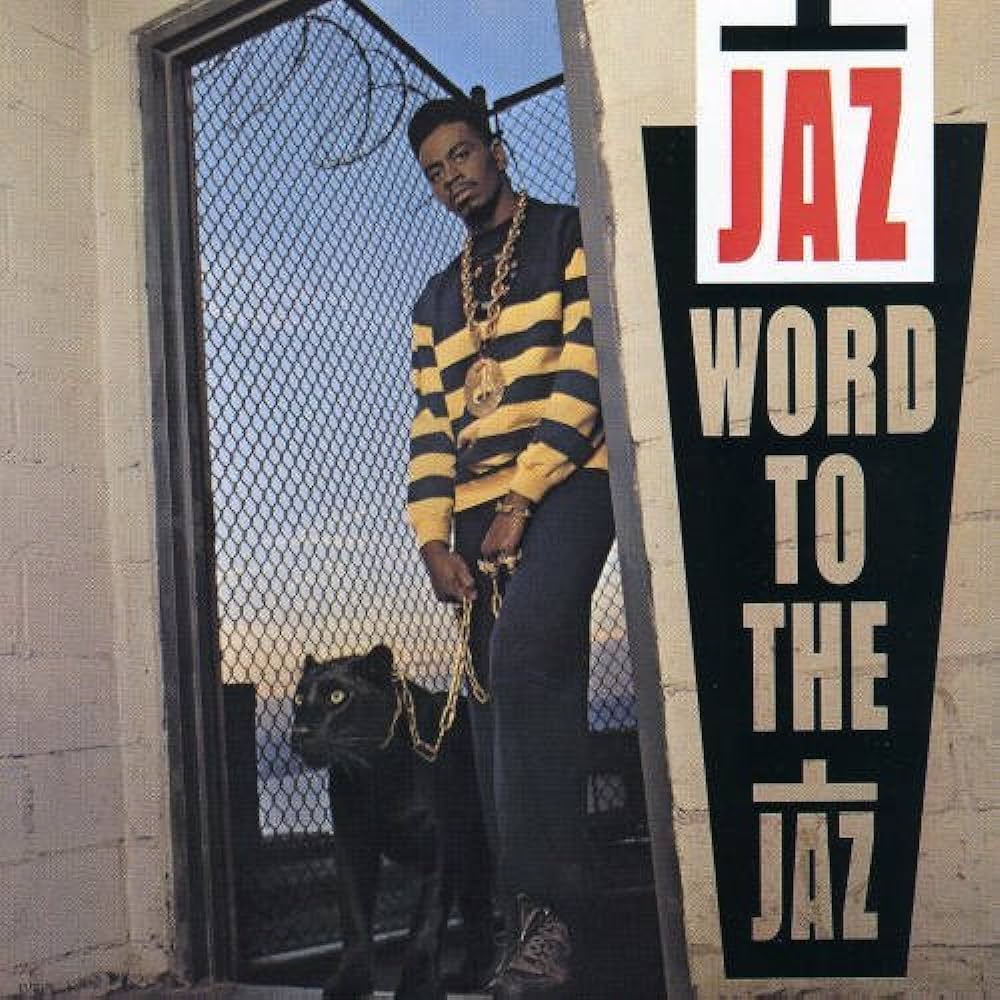
The album cover for WTTJ displays Jaz posted up with gold finger rings and a dookie rope gold chain with a Cobra-Spinx medallion around his neck, with a leashed black panther by his side. LL Cool J’s Walking With A Panther album would don a similar cover, with LL squatting next to a black briefcase, while a black panther sits in front of him sporting a gold dookie rope. WTTJ came out a month before WWAP. Were the similarities in the album covers a coincidence or a classic case of biting? I’d love to hear what Jaz and LL have to say about the matter.
Dance To This – Jaz kicks things off with a danceable mid-tempo instrumental and lyrically embarks on a mission to get the listener up to shake that ass. His tone and swag sound a lot different from my introduction to him on “Bring It On,” as he sounds more wholesome than he would later in the mid-nineties. Jaz sounds adequate on the mic and even gives a bite-size sample of the speedy rap style that Jay-Z would use during his early nineties string of cameos. Speaking of Jay-Z, he makes his first appearance of the night, sharing a few words in between Jaz’s verses. It felt kind of odd to hear a hip-hop album start with a low-energy party joint, but it’s still a decent record.
Pumpin’ – Jaz follows up the previous low-energy track with a boost, thanks to a sexy bass line borrowed from KC & The Sunshine Band’s spin on George McCrae’s “I Get Lifted.” It’s worth noting that Big Daddy Kane rapped over the same break from McCrae’s version on “Mortal Combat.” Jaz sounds serviceable over the break, but make no mistake about it, he’s no Kane (who along with MC Shan, Rakim, Chuck D, and KRS-One, Jaz graciously shouts out during his opening verse). Jay-Z makes another minimal contribution to the record, adding a few words in between Jaz’s verses. All in all, another decent record.
Hawaiian Sophie – When Nas mentioned Jay-Z’s “Hawaiian Sophie fame” on “Ether,” at the time, I had no idea what he was talking about. Later, I would find out it was a record on WTTJ, which I also didn’t know existed before Nas’ diss track. The song features Jaz rapping about a trip to Hawaii where he meets and falls for a bangin’ Hawaiian chick named, you guessed it, Sophie. Jaz spends the length of the song trying to win the heart and affection of the Island hottie, but Sophie’s brolic Hawaiian boyfriend (I think it’s her boyfriend, but it’s never clearly confirmed) stands in the way. In true pseudo-masculine barbaric fashion, the two men square up to decide who gets the girl, instead of just asking her who she wants to be with. Other than one or two adlibs (and appearing in the video), Jay-Z’s cameo was just as minimal as his previous contributions on WTTJ, which explains Nas’ tongue-in-cheek reference to his “fame” on this record. Jaz’s storyline is average at best, but I thoroughly enjoyed the Bo Diddley drum loop under the lap steel guitar sample. It sounds like D.C. Go-go crashing a Hawaiian luau.
Give A Little Extra – Our host gets struck by the love bug on this track, and like a man newly in love, he’s prepared and willing to go all out for his new boo. Jaz gets vulnerable during the second verse, recalling a failed relationship with a cheating partner (whose family he hi-lariously puts on blast for being on welfare and using food stamps), and the third verse he uses to give a Sesame Street elementary-level PSA on being faithful to your mate, which comes off corny in a naive kind of way: “Cheaters never win, they live a life of sin, skeezin’ is for heathens, and loyalty’s in…so if you really love someone, cheatin’ ain’t smart, your relationship will tear apart, you’ll break somebody’s heart.” Jaz’s positive message is scored by a loop from The Sylvers’ “Misdemeanor” (the same one Dr. Dre used for The D.O.C.’s classic “It’s Funky Enough”), which sounds cool, but things get choppy during the hook when a second loop from the same record is brought into play.
Fun – Jaz has one goal on this record: to have an unadulterated drama-free good time. His rhymes aren’t spectacular, but his untainted perspective and pure message were refreshing. The Dennis Coffey-aided funk groove, along with the blaring jazzy horn break during the hook were pretty entertaining, though.
Word To The Jaz – If you’re listening to WTTJ on vinyl, this title track marks the end of side one. Our host gets into some good old-fashioned boasting, and I have to admit, I almost clutched my pearls when I heard him drop an F-bomb, as his bars have been relatively clean up to this point. Jaz’s rhymes were passable but other than the tantalizing horn break in between verses, the instrumental was blander than Bobby Blue. Easily the weakest track on side one of the album.
Let’s Play House – In the late eighties/early nineties, house music was all the rave, and several rappers made house-fused hip-hop records. The Jungle Brothers made “I’ll House You,” Queen Latifah gave us “Come Into My House,” De La Soul got “Kicked Out The House,” and MC Shan made sure you knew “It Ain’t A Hip-Hop Record.” You can add this song to that list. Like all the other records that jumped on this trend, this one also feels contrived, but like most of those records in that sub-genre, I enjoyed the fusion.
Boost Up The Family – Jaz gets into his conscious bag, calling for peace, justice, and unity in the Black community, fittingly backing his content with tribal-esque African drums. I dug the message, the instrumental was decent, and I absolutely love the drowsy jazzy horn break brought in during the hook.
Shana – Shana might be the chick that broke Jaz’s heart during the second verse of “Give A Little Extra” (you know, Ms. Welfare). He dedicates this song to the conniving gold digger and cleverly samples The Silhouettes’ fifties doo-wop classic, “Get A Job,” to assist with the music and calling her out by name during the hook. The instrumental feels a little Fresh Prince of Bel-Airish, but it’s a catchy record that will win you over after a few listens.
I Can Dig Rappin’ – Jaz uses this one to discuss the rise of rap music, gives a brief history on the art of rapping (which is severely in need of some fact-checking), and for the second time on the album (the first time came during “Dance To This”) he mentions his former life as a singer that he apparently gave up to become a rapper: “I was once a singer, but I had to renege it, rap is the move today, and I can dig it” (I’ve heard Jaz mention in an interview that he was offered a singing deal with an unnamed label but turned it down. Later, the same label would offer the deal and sign Keith Sweat (I’m going to assume the label was Elektra, as that was Keith’s label home for the fruitful years of his career). You can also hear Jaz sing on the hook to Jay-Z’s “Ain’t No Nigga,” which he’s also credited with producing). Jaz’s rhymes are backed by up-tempo drums, a hyperactive bass line, and a James Brown co-sign on the hook. I could definitely see B-boy gettin’ busy to this one back in ‘89.
Look Out – Over a basic drum beat and a few slight musical accessories, Jaz goes into battle mode, coming “harder than an ex-con,” which makes for a very pausable moment. It’s s not a terrible record, but I wasn’t crazy about it either.
Buss The Speaker – Jaz puts on his clergy collar and steps back on his soapbox to get off an album-closing sermon that charters the same territory as “Boost Up The Family,” and for those keeping track at home, he drops his second F-bomb of the evening: “Fight for justice, peace, and education, non-discrimination, and equal representation, we got the power, so give some resistance, equal opportunity, fuck welfare assistance, purchase from your own and your community too, and in time ya see money come back to you, those in position, you sit on a throne, you’re hiring them, you better hire your own.” Jaz and company create a decent instrumental with their flip of the overly used James Brown sample, and it’s hard to say anything negative about positive content, so I won’t.
As I mentioned during the intro, my introduction to Jaz-O came from Jay-Z’s “Bring It On,” where he was running with “drug dealing apostles,” “bangin’ bitches out the Bahamas,” and never putting “the pure brown sugar before the dirty green cream.” So, I was a bit baffled when I heard him denounce drug dealing and side chicks with the mission statement: “To restore the good thoughts and release the foul” on Word To The Jaz. It almost sounds like life and time tainted his view of the world in the seven years between WTTJ and Reasonable Doubt, or maybe he changed his approach to rhyming as thug drug raps became more popular and lucrative in the mid-nineties.
The wholesome unjaded version of Jaz-O is still a competent emcee, and while there are a few cringe worthy “goody-two-shoes” moments on the album, most of Jaz’s youthful optimism was refreshing to hear, even if it is phony. The back album cover, which shows Jay-Z posing with Jaz and receiving a “special guest appearance” credit, made me believe he was going to give a Ghostface Killah on Only Built 4 Cuban Linx type assist, but he doesn’t even get to spit the half a bar he gave to his adversaries not named Nas or Mobb Deep on “Takeover.” Matter of fact, Jay’s contribution on WTTJ is so minimal that if you sneeze while listening to the album, you could miss it. Even without much help from Jay, Jaz proves to be an efficient enough emcee to carry his own weight on WTTJ, as he does a decent job navigating the bundle of standard eighties east coast hip-hop instrumentals.
Unfortunately, decent and standard will sometimes leave you forgotten. Or remembered for putting someone else on who made a more memorable mark.
-Deedub
Follow me on Instragram@damontimeisillmatic


 Time Is Illmatic
Had this on vinyl. I still have To The Soul on CD.
I didn’t know of Jaz O until he was working with Jay Z. With the Jigga What? Jigga Who? song and video in the late 90s. Which I liked. Back in 2003 while visiting Atlanta I went to a shop that sold used CDs. I ended up finding a copy of his 1991 EP. I looked through the credits with songs produced by 45 King, Large Professor, and Prince Paul. Was I disappointed when I heard it. It was horrible. Never played it again.
He was also on “Bring It On” off the Reasonable Doubt album in ‘96….Really? The EP was that bad? I’ve never heard it, but I thought with all those heavyweight producers at least the production would be fire.
I didn’t like it. I thought the same thing with all those heavyweights. I didn’t hear “Bring It On” until years later. I bought at that same store the “School Of Hard Knocks” CD. R.I.P to Mark The 45 King.