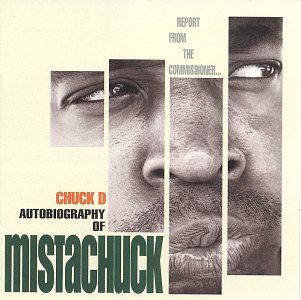
From 1987 until 1991, Public Enemy was arguably the biggest and most respected group in all of hip-hop. Led by the booming voice of Chuck D and his politically charged conscious themes, along with a muted deejay (Terminator X), a steppin’ Black army (The S1Ws), and the resident court jester and yin to Chuck’s yang, Flavor Flav, the Long Island collective were able to touch the masses with their music, obtaining tons of commercial success (their first five albums all sold gold or better), while never compromising their Black militant stance. But like all good things, PE’s reign on top begin to come to a close after their dismal 1994 release, Muse Sick-N-Hour Mess Age, which still earned PE a gold plaque, but it was clearly subpar for PE standards, and both the streets and critics would attest to that. PE would take a five-year break after Muse Sick, but during their hiatus, Chuck D would start his solo career, releasing his debut solo album on Mercury Records, The Autobiography Of Mistachuck.
Chuck D would handle most of the production duties on Mistachuck (rightfully so based on the album title) with a slew of co-production credits handed out, including a few going to some of his old Bomb Squad bredrin. Chuck would release one single from Mistachuck (though I’ve never heard it before) and the album would be the first Chuck D involved project to fail commercially.
To be honest, I didn’t even know Mistachuck existed until about seven or so years ago when I found a copy staring at me as I shuffled through the used CD bins at one of my favorite record stores. Yet again, another album that I haven’t listened to since I bought it and will be experiencing it with you all for the first time. The further we get into ‘96 and begin 1997, I’m sure this scenario will be a reoccurring theme.
Mistachuck – The album opens with a clip from the Spike Lee Joint, Clockers, where a few brothers are debating whether Chuck D is dope or not, and one of the guys (played by Fredro Starr from Onyx) emphatically thinks Chuck sucks as a rapper and goes as far as to call him a bitch ass nigga. Then after a few adlibs from our host, a diabolical soulful groove drops and Chuck addresses his haters, boasts about his frugalness (“I don’t care for Range Rovers, cause the price is too high and I feel ‘em gettin’ over”), and humbly reminds us that his track “record speaks for itself.” I like the sonically big energy of the track (the futuristic laser beam like breaks in between the second and third verses are sick) and “the voice that got muscles in it” actually sounds nice rhyming over this soulful dish.
No – Chuck sticks with the soulful vibes from the previous track, as he and Mark “Mr. Elite” Harrison cook up a mid-tempo bop that he uses to list all the things the world would be a better place without (which in his opinion includes the whole DeBarge family…damn, Chuck). I like the instrumental, but Chuck’s flow sounds a little disjointed, and his bars were underwhelming.
Generation Wrekkked – Chuck continues to defend his name and legacy on this one: “Now I’m the one who flew over the Cuckoo’s nest and tested, and wasn’t ever bulletproof vested, resurrection of the one-man vocal section, spirit in your dark ass direction, for your mind, body and soul protection.” I like Chuck’s refrain (“If I can’t change the people around me, I change the people around me,” which would later become the title for one of his solo albums) and the stripped-down James Brown-esque break beat paired with Kyle “Ice” Jason’s very Curtis Mayfield influenced hook was decent, but Chuck once again sounds uncomfortable rhyming over this beat.
Niggativity…Do I Dare Disturb The Universe? – Chuck definitely sounds more comfy rhyming on this unnerving and scarce backdrop that finds him declaring “The rhyme animal has resurfaced, wreckin’ all elements, destroyin’ all irrelevance,” as he uses the next three verses to awaken his people from their mental slumber. This one end with a snippet of the Flip Squad (not to be confused with Busta Rhymes’ Flip Mode Squad, the Flip Squad, comprised of K.K. Holiday, Bootleg and Lady Gi, hosted the 6-10pm drive time show for the pioneering Atlanta Hip-hop station, 97.5 FM) showing love to Chuck D and the album.
Free Big Willie – Chuck and ‘em loop up a little Isley Brothers to create this soulful set that finds our legendary host, still very confident but a little salty (a portion of the hook says: “Although I’m feelin’ alright, it’s feelin’ funny feeling left out”), and the salt has seeped in his wounds enough to once again make him address his naysayers and defend his legacy: “Got more hits then Pete Rose when he played for the Reds, now they be on anything Deion intercepts…Back like Rock ‘Em Sock ‘Em Robots, who forgot it was him, who parlayed the styles of KRS and Rakim, and brought it to different level, against the so-called devil, who had the nerve to throw a bell curve and test me, arrest me.” Talk your shit, Chuck.
Horizontal Heroin – Whatever rift Professor Griff (bars!) and Chuck D had after Griff left Public Enemy (or got kicked out) was apparently squashed by 1996, as he stars on this track and gets off a conscious spoken word poem.
Talk Show Created The Fool – Some off y’all might be too young to remember, but years before Reality TV shows (which in reality are just as fictional as scripted TV shows) took over television programming, there was a time when salacious daytime talk shows were all the rave. Over a drearily moody backdrop, Chuck and his guests, Abnormal (who’s also credit for the instrumental) and C. Brewser call out talk show hosts that they feel were exploiting people (shoutout to Jenny Jones, Ricki Lake and Montel Williams) and reprimand the clowns who go on these shows seeking fifteen minutes of fame. An uncredited male vocalist does his best Curtis Mayfield impersonation on the hook (I don’t think it’s Mr. Jason from “Generation Wrekkked,” though) and the sarcastic refrain (“laziness is in the house, slobs with no jobs is in the house”) is hi-larious. The song is followed by another Flip Squad skit, where Da Brat makes a brief appearance.
Underdog – Over a gray understatedly jazzy backdrop, Chuck goes from once being hip-hop royalty to assuming the role of an elder statesman underdog with his back against the wall, defending his rep but still feeding us thought food: “Ashes to ashes, blunts to blunts, some of these G’s ain’t real, I seen ‘em once, upon a time, so many rhymers and not enough rhymes, I hope they around next year, but I fear, I’m all-time, and I’m down for the roughness, but what good is a rhyme without substance?” By the way, I think French Montana got his signature “Hah” adlib from the intro of this song.
But Can You Kill The Nigger In You? – This one starts with a movie snippet of a couple of white men talking about the difference between indentured bond servants and Black slaves, before the song starts and in his own pessimistic roundabout way, Mr. Chuck calls for Black unity in the community. The legendary Isaac Hayes (rip) pops in and adds a few words, notes and a little instrumentation to reinforce our host’s sentiments. Kudos for the uplifting message, but this wasn’t it.
Endonesia – Chuck introduces and invites a couple of guests to join him on this cipher session: B-Wyze and Dow Jonz (whose delivery vaguely reminds me of DMX). The trio take a break away from conscious content and get into some good old fashion boastful freestyles (which includes a clever verse from B-Wyze that references no less than twenty-one different movie titles). All though hes’ obviously isn’t our host’s strong point, and his guests rap circles around him, but Chuck’s hook and hard instrumental (with a co-credit going to Gerald “Soul G” Stevens) are the true star of this one. This is followed by another Flip Squad skit.
The Pride – Over more soulful instrumentation, Mr. Chuck reminisces about his childhood, recalling different Black historical figures, organizations and events that helped mold him into who he is today, because as he so simply puts it: “There is no IS without a WAS.” To hear Chuck D say he was in third grade when MLK was assassinated is stark reminder that the civil rights movement wasn’t that long ago. Time is truly, illmatic.
Paid – After one final Flip Squad skit, the last song of the evening features more guest cameos, as Mr. Chuck invites Kendu and Melquan to join him on this one. His guests (who sound like standard backpack rappers) must have missed the memo about the song’s concept, as they both spit random freestyles, while Chuck stays on task, advocating for rappers to get paid by the record companies for their music. Chuck’s bars were noble, but this record was completely unnecessary. If you stick around until the nine minute-twenty second mark (or fast forward to it) you can hear Chuck get off what he calls “The Ten Resentments of the Industry” delivered in two different demonically distorted voices over the most lazy and random organ chords, which added absolutely nothing to the album.
The album title would lead you to believe that Chuck D is going to open up and get personal, sharing details about his upbringing and getting vulnerable about different parts of his life. Chuck does briefly touch on his childhood and some of the events that shaped and molded him (i.e., “The Pride”), but most of Autobiography Of Mistachuck finds our host rapping with a newfound chip on his shoulder, forged by Father Time and the natural changing of the guard that comes with a new crop of rappers and hip-hop fans.
Mistachuck is definitely the most we’ve ever heard Chuck D participate in boasting, as that chip has him defending himself and reminding listeners of his cemented legacy. But don’t get it twisted. Mr. P.E. also shows up and serves a healthy portion of substance and consciousness. Chuck does struggle to find his pocket on a few tracks, and a few of the songs toward the end of the album could have been scrapped, but overall, Chuck does a solid job navigating the more simplified soulful stripped-down batch of beats than the busier production scheme we’ve grown accustomed to hearing him rhyme over during the prime P.E. years. Proof that you can teach an old dog new tricks.
The last Public Enemy album I listened to was Muse Sick, but over the past ten years, I’ve collected most of the latter side of PE’s catalog. God willing, I’ll get to thoroughly listen to them all someday. Hopefully, Mistachuck is an indication that Chuck and the crew would refocus and at minimum, churn out decent material on those projects. Stay tuned…
-Deedub


 Time Is Illmatic
I have this album on cassette and haven’t heard it for years. I remember at the time 1996 I thought it wasn’t a bad album but not great either..6.5 out of ten I’d give Chuck..I was hoping for better
It’s not a poor album but not a patch on Public Enemy
I remember back in 1996. Seeing an ad for this in The Source. Then checking out the video for No on BET Rap City. It didn’t catch my attention to go get the CD. Even though I was a big PE fan. I didn’t get until a few years ago. Only because a friend had an extra copy and gifted it to me. Kendo on the song Paid is from Hyenas In The Desert who put out an EP the following year on Chuck D’s label Slam Jamz. Which was decent but went no where. Now he has a bicycle business.
I have this CD. I haven’t heard it in a long time. I will have to pull it out and listen again.