There’s an old saying that laughter is the best medicine, and scientific evidence supports that claim. It’s been proven that laughing enhances your oxygen-rich air intake, increases the endorphins released by your brain, stimulates your heart, lungs, and muscles, helps relieve stress, and can improve your overall emotional state and mood. This medication comes in many different forms: a good joke, when an old incident suddenly pops into your head, brutally honest comments from the mouths of babies, a look, a gesture, and sometimes, a song. Since its inception, hip-hop has provided numerous comedic rappers looking to heal the listener’s soul (or earn a buck) through the healing virtues of laughter. The Fresh Prince, Biz Markie, Flava Flav, Ol’ Dirty Bastard, Redman, D12. And even more recently, emcees like Danny Brown and Lil Dicky. But way before any of these jokesters would grace the genre, the OGs of hip-hop court jesters, Fat Boys, would lay the funny foundation.
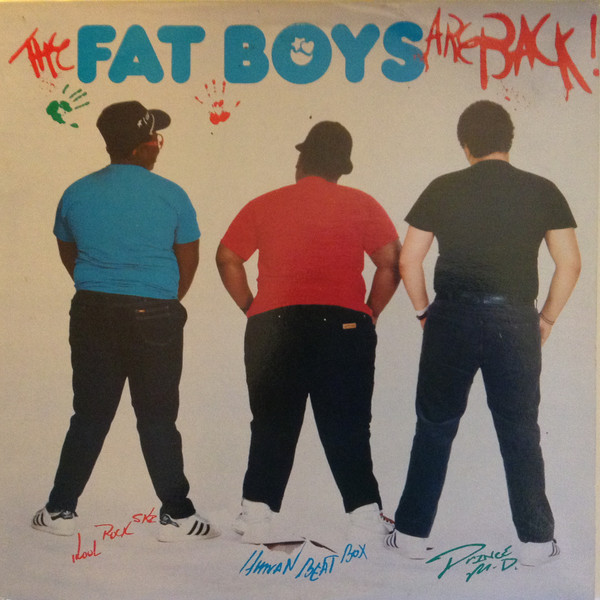
The Fat Boys were a three-man team (comprised of Mark “Prince Markie Dee” Morales, Damon “Kool Rock-Ski” Wimbley, and Darren “Buffy” Robinson, aka The Human Beat Box) who met as teens growing up in Brooklyn, New York. Legend has it that the trio met and bonded by playing football in the Brooklyn streets and eventually began rapping, formed a group, and called themselves the Disco 3. While most groups had emcees and a deejay, what set the Disco 3 apart was their secret weapon, Buffy The Human Beat Box, who was not only the group’s deejay but could create beats with his mouth. Buffy’s unique ability would help the Disco 3 stand out in a crowd and eventually would help them win a talent show in The Bronx with a record deal as the grand prize. The teenage trio would sign a deal with Sutra Records, change the group name to Fat Boys, releasing their eponymous debut album in May of 1984, with the album cover displaying a pic of the threesome holding a pizza, hamburger, soda, and ice cream to reinforce their self-deprecating “fatso clown” image. It all worked, as the album would earn the Fat Boys their first gold plaque. They would return the following year, simply titling the album The Fat Boys Are Back.
Like their debut, TFBAB would be entirely produced by Kurtis Blow (who was also the first rapper to earn a gold plaque with his 1980 single, “The Breaks.” That stat might deserve an asterisk next to it, as The Sugarhill Gang’s “Rapper’s Delight,” released nine months before “The Breaks,” has sold well over five hundred thousand copies, but because Sugar Hill Records co-founder Joe Robinson refused to pay for an RIAA membership, the record was never certified). TFBAB would peak at sixty-three on the US Billboard 200 and earn the chunky crew their second consecutive gold plaque.
The Fat Boys would release five more albums between 1986 and 1991, with two earning gold certifications, before the trio decided to go their separate ways. Prince Markie Dee would go on to write for the likes of Shabba Ranks and Mary J. Blige (he helped pen her classic single, “Real Love”) and would experience moderate success with his solo career, releasing two albums, Free in ‘92 and Love Daddy in ‘95. Sadly, Buffy would pass away at the tender age of twenty-eight in December of ‘95. In 2021, Prince Markie would pass, leaving Kool Rock-Ski as the lone surviving member.
I bought a used vinyl copy of TFBAB a few months ago. Let’s jump into it and see how it’s held up over the years.
The Fat Boys Are Back! – The FBs kick off the album with this title track (which was also the lead single) as they celebrate their return to the mic with large amounts of gluttony. Mr. Blow provides a cheesy synth canvas with the perfect dosage of zaniness to match Prince Markie Dee and Kool Rock-Ski’s whimsical brags and boasts of eating and drinking themselves into a food coma. Buffy gets off a beatbox during the final verse, and a few uncredited ladies sing the hook to round out this musical in food buffoonery.
Don’t Be Stupid – Our hosts follow up their hijinks on the opening track with far more serious content on this one. Markie Dee and Rock-Ski outline three cautionary tales (a bank robbery, the abduction of big booty Judy, and a gambleholic) about making bad decisions. Even though the rhymes sound primitive, I can appreciate the message, and the aggressive guitar riffs and tough bass line were semi-dope.
Human Beat Box Part II – Part one was on the Fat Boys’ debut album, featuring Buffy as the main attraction, providing the music with his mouth while Markie Dee and Rock-Ski rapped praises to his beatboxing abilities. Part two follows the same format and yields the same middling results, but I’m sure Buffy’s beatboxing sounded more impressive live than on record.
Yes, Yes, Y’all – The FBs wrap up side one of the album (if you’re listening to it on vinyl) with this lighthearted joint. Kurtis lays down cool drum claps accompanied by a few simple but effective synth chords as the trio each gets off a verse. Buffy kicks things off with a rare verse (and it quickly becomes clear why he’s usually regulated to only beatbox duties), followed by a random nonsensical story about The Incredible Hulk from Markie Dee, and Rock-Ski closes things out with passable braggadocious bars. Mr. Blow’s backing music is easily the most entertaining part of this record.
Hard Core Reggae – Side two of TFBAB begins with a slow-rolling reggae-flavored track, lined with a thick hypnotic bass line that Markie Dee and Rock-Ski use to take turns paying homage to some of reggae’s pioneers. Markie Dee sounds absolutely horrible on the first verse, sloppily talking his way through it as he lists some of the genre’s greats. Rock-Ski fares a little better but struggles to find a pocket and sounds uncomfortable over the beat; he does add a dope MOP-esque adlib that I’m shocked Premo hasn’t scratched into a record at some point over the past thirty-plus years (“Sit ‘em down…shoot ‘em up…sit ’em down…shoot em up!”). This record has great intent with poor execution. The instrumental was solid, though.
Pump It Up – The first twenty-five seconds or so of this track sounds like a goofy Three Stooges skit. Then Kurtis Blow drops a shiny and smooth groove backed by a subtly funky bass line, as Markie Dee and Rock-Ski shoutout a few of their peers, boast a bit but mainly use it to spew feel-good party rhymes. And, of course, they leave room for Buffy to get off a few beatboxes that feel a bit forced. Much like the previous track, Kurtis Blow’s production is the star of this record. Side note: The Fat Boys performed this song in the movie Krush Groove, which hit theaters about four months after TFBAB was released.
Fat Boys’ Scratch – When he wasn’t fulfilling his role as the group’s resident Human Beat Box, Buffy would transform into the group’s deejay, Doctor Nice. Over a basic drum beat, Markie Dee and Rock-Ski talk up Buffy’s deejay skills, only for him to disappoint with pedestrian scratches and cuts. It was such a pedestrian performance that Kurtis Blow fell asleep during the session, according to Markie Dee’s closing adlibs.
Rock-N-Roll – The Fat Boys close the album with another short goofy interlude before the rock guitar- fueled backdrop comes in for Markie and Rock to get off one last round of lackluster boasts and battle raps. Buffy manages to sneak in a beatbox bridge that sounds completely out of place. I wonder if Kurtis Blow’s rock-fused instrumental was the catalyst for Run DMC’s collab with Aerosmith in remaking their hit record, “Walk This Way,” the following year. Hmmm…
I went into listening to The Fat Boys Are Back with very low expectations. Even though I’ve never listened to a Fat Boys album in its entirety before this, I’m familiar with enough of their songs to gather a decent idea of what audio experience a full album from the weighty crew would sound like. I got exactly what I expected from the Fat Boys with this album, yet the album exceeded my expectations. Allow me to explain…
Prince Markie Dee would become a much better rhymer after leaving the Fat Boys and starting his solo career, but during his Fat Boys stent, he and Rock-Ski were far from lyrical monsters. In fact, they are the epitome of the elementary rhyming from the early eighties that I find so hard to listen to today. Overly simplistic rhymes, a few beatbox solos, and a touch of slapstick comedy are what I anticipated and received from our heavy hosts, but Kurtis Blow’s production was a bit of a surprise. I wasn’t necessarily blown away by Kurtis’ production (no pun intended). However, when you mentally set the bar as low as I did for this album, just one mediocre instrumental is enough to exceed expectations. To my surprise, Mr. Blow was able to chef up not only one but four instrumentals that range from decent to solid, giving TFBAB some redeemable value.
The Fat Boys should be applauded for their contribution to showing that hip-hop music could be a commercially viable art form, loved and embraced by fans around the globe. The irony is over time, their fat shtick and mediocre music have left questions about their authenticity and loomed much larger. Pun intended.
-Deedub
Follow me on Instragram@damontimeisillmatic


 Time Is Illmatic
I just graduated high school when this came out.