I recently read a social media post that listed the best rap duos of all time. I typically scroll past this type of post because they’re subjective and usually put together by people who didn’t start listening to hip-hop until the late nineties, disregarding everything and everyone who came before 1998. But for some reason, I took the time to comb through this one. Some of the names on the list were egregious (so egregious I won’t mention names), but there were quite a few deserving a spot on the list: OutKast, Mobb Deep, Clipse, 8Ball & MJG, and Black Star. All great choices. There were also some glaring absentees. Two that stood out to me immediately were Q-Tip and Phife (of A Tribe Called Quest), and the subject of this post, EPMD.
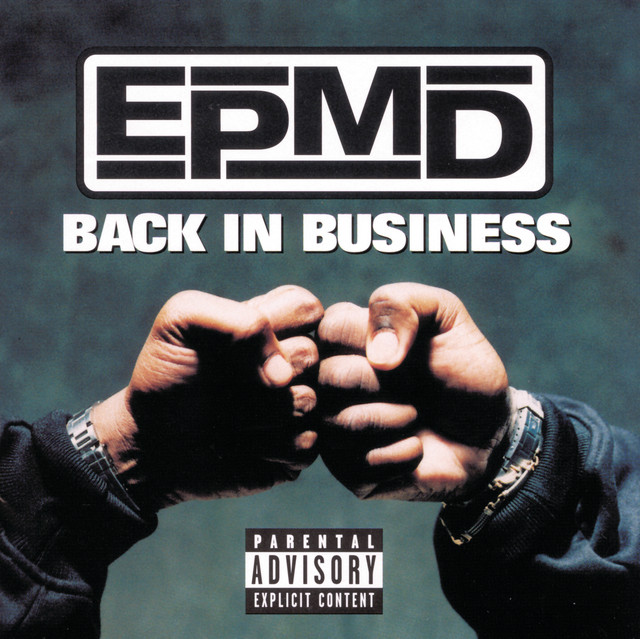
Between 1988 and 1992, Erick Sermon and Parrish Smith, better known as EPMD (an acronym for Erick and Parrish Making Dollars), put together one of the most impressive four-album runs in hip-hop history. Strictly Business, Unfinished Business, Business As Usual, and Business Never Personal were all critical darlings, and each earned the duo a gold plaque. Ironically, during the recording of Business Never Personal, E and P began to dispute over money, Parrish’s home was broken into (which Parrish felt Erick orchestrated), and the two went their separate ways, bringing the legendary EPMD run to an end. At least temporarily. Erick and Parrish would put their differences aside (home invasion and all) and reunite after a five-year break to release their appropriately titled return album, Back In Business.
Back In Business would be the duo’s fifth group effort and their third release on the legendary Def Jam label. A five-year hiatus wouldn’t affect EPMD’s Midas touch, as BIB would be their fifth consecutive album to earn gold certification. Their Midas touch may still have been intact with BIB, but it received mixed reviews from the critics.
EPMD is one of my favorite hip-hop groups of all time, but I stopped following them after the Business Never Personal album (I guess you can say EPMD and I both went on hiatus). When I saw this one in my review queue, I got excited. I’m hopeful that it lives up to the EPMD standard.
Fun Fact: EPMD were originally going to call the group EEPMD (Easy Erick and Parrish the Microphone Doctors). Dropping one of the E’s was a wise decision, fellas.
Intro – The album opens with E and P informing the listener that they’re back, just in case you weren’t aware that you were listening to an EPMD album. Then somebody gets shot and splashes into a body of water. Not sure what the purpose of this was, but like ninety-eight percent of hip-hop album intros, it was useless.
Richter Scale – E-Double builds the backdrop around a flip of a mildly funky Average White Band loop (that you’ve heard used before on songs like Big Daddy Kane’s “Mr. Pitiful” and Puff Daddy’s “Friend”). Erick shows and proves that he still has the gift of gab (and allegedly, packs “a hell of a jab” to go with it). Meanwhile, Parrish keeps pace, sounding cool and calm with his signature slow flow. It’s a cool record, but I prefer more energy from the opening track on an EPMD album.
Da Joint – Now this is the energy I needed on the previous track. For the album’s second single, The Green-eyed Bandit pairs up with Rockwilder, as the two turn a virtually non-descript Gladys Knight & The Pips clip into a mammoth banger. E and P lace it with standard EPMD bars and a cool homage to the hip-hop pioneers, Funky 4 + 1, on the hook. This was complete fire.
Never Seen Before – This was the lead single, originally released on the How To Be A Player Soundtrack, which explains the track’s musical vibes. Erick and Parrish get their pimp strut on over a Meters loop that sounds like it could be Iceberg Slim’s theme music.
Skit – Completely useless skit alert.
Intrigued – EPMD tag teams the mic with Das EFX (who stay true to the often-jacked stuttering style they fathered, making a few alterations to it and how it’s delivered so it doesn’t sound gimmicky or dated) as all four emcees get loose and entertain over a soulfully explosive Erick Sermon-produced instrumental.
Last Man Standing – Mr. Sermon loops up a Love Unlimited Orchestra sample, turning it into a rugged yet smooth funk groove (it reminds me of the slick backdrop from “Manslaughter” off the Business As Usual album, which ironically, sampled a different Love Unlimited Orchestra record). Erick and Parrish’s hardcore rhymes, along with the Prodigy vocal snippet on the hook, give the track a dark and edgy feel, capturing the essence of late-nineties New York hip-hop.
Get Wit This – This record marks the midway point of Back In Business, which has already given us some great production, but this one is a weapon of mass destruction. E-Double combines a confidently bellowing bass line with an uber-cool piano loop, and the two elements sound phenomenal together with little effort. Erick and Parrish sound dope rhyming over it, but they could have rhymed the alphabet over this beat and still sounded great.
Do It Again – Looping up Tom Browne’s “Funkin’ For Jamaica” in 1997 wasn’t a super original hip-hop idea. But at least Erick gives it a unique flip, completely abandoning its irresistible melody to build around its stripped-down, nasty bass line. Well played.
Apollo Interlude – As great as the songs on Back In Business have been to this point, the interludes have been pointless and pure ass, including this one.
You Gots 2 Chill ’97 – Yep, the song plays just as it reads. E and P bring back the funky “More Bounce To The Ounce” sampled instrumental from their 1988 hit record and make a few updates to the O.G. rhymes. I’m torn on this one. Part of me feels like it’s blasphemous to touch a classic record of this magnitude, but I also semi-dig the nostalgic vibes it brings. My feelings about this remake change with each listen.
Put On – E and P swap street tales about a bunch of “shiesty muthafuckas” and dress it up as a cautionary tale for the listener, even though anybody involved in the streets already knows that shady characters come with the territory. DJ Scratch’s husky instrumental was solid, but Erick and Parrish’s storylines were too involved and not interesting enough to care.
K.I.M. – EPMD are joined by Redman and Keith Murray for what ends up being a Parrish Smith and Def Squad cipher session. I love the warm symphonic feel of E-Double’s instrumental, and all four parties involved do their thing over it, making for a solid posse joint. The record left me with two questions. 1: Where is K-Solo? 2: Since Keith Murray promises during his verse to give “a g a week for life” to the emcee that can defeat him, does that mean he’s sending Fredro Starr a weekly check?
Dungeon Master – Agallah (whom I first became familiar with as 8-Off for his production work on PMD’s Bu$ine$$ Is Bu$ine$$ album) receives co-credit with PMD for this emotionally gully backdrop that sounds like it could be the blueprint for Alchemist’s early work. Erick and Parrish share the first verse and quickly get out of the way for Nocturnal (not to be confused with Knoc-turn’al from the West Coast), whose gritty flow and rhymes blend perfectly with the music.
Jane 5 – There are two things you can be sure of with every EPMD album: “Business” in the album title and a “Jane” record. Jane is the fictional EPMD groupie/stalker (with an Anita Baker haircut) who, throughout the series, has tasted the microphones of both MDs. The first three Jane records were playful, then things got a little dark on part 4 (“Who Killed Jane?”) when Jane comes up dead and PMD is charged with her murder. “Jane 5” picks up where “Who Killed Jane?” left off, and the storyline comes with quite the plot twist. “Jane 5” is the first time in the series that both E and P didn’t participate, as E-Double sits this one out and lets PMD deal with Jane solo. I’ve never been a big fan of the “Jane” series (although Part 3 was mildly entertaining), and this record didn’t change my opinion. I do respect EPMD for upholding tradition and seeing this Jane thing through til the end.
Never Seen Before (Remix) – This remix recycles the lyrics from the original, but dumps its pimp funk vibes in exchange for a melodic, danceable music bed. It goes against the hardcore EPMD sound they’ve faithfully stood by throughout their run, but I thoroughly enjoyed it much more than the original mix.
During their break-up, Parrish and Erick begin their own separate business ventures (pun intended). Parrish released a few solo projects and served as an EP on a few of Das EFX’s projects, while E-Double would also release solo albums and produce a slew of tracks for his Def Squad crew members and others. Both experienced moderate levels of success as solo artists (E-Double more so than PMD). But thankfully, the two would put the funny business behind them, becoming business partners again, allowing EPMD to get back to business.
With Back In Business, PMD and the Green-Eyed Bandit pick up where they left off in ‘92 without missing a beat. The duo stays true to their M.O.: “hardcore braggadocious” rhymes placed over “mackadocious funk material.” They make a couple of tweaks to keep their sound current (by 1997 standards) but still maintain that vintage EPMD sound. Erick and Parrish have never wow’d with lyrical miracle. Instead, they keep hitting you with steady jabs and an occasional witty uppercut, and their chemistry makes the rhymes sound even stronger. The Microphone Doctors keep the cameos to a minimum on BIB, and none of them are wasted, as every guest (Das EFX, Redman, Keith Murray, and Nocturnal) makes sure their presence is felt. I would love to have gotten a verse from K-Solo, though.
Erick Sermon leads the charge on the production side of BIB, with PMD, Rockwilder, DJ Scratch, and Agallah lending a helping hand, here and there. I’ve often criticized E-Double for his inconsistent production on his solo work, but there must be something about working with PMD that brings out the best in his hands and ears, as the music on this album is pretty tough from beginning to end. There are a few moments that are less than spectacular (like “Richter Scale,” the O.G. mix of “Never Seen Before,” and the rehashed instrumentals for “You Gots 2 Chill ’97” and “Jane 5”). But the majority of the album is filled with exhilarating bangers, with “Da Joint” and “Get With This” serving as the album’s Crown Jewels (the “Get With This” instrumental might be a contender for top five hip-hop beat of 1997).
At the beginning of this review, I mentioned EPMD’s impressive four-album run. Correction. Make that impressive five-album run. BIB is the ideal progression I’d want EPMD to make after returning from a five-year break. Without question, EPMD is one of the greatest hip-hop duos of all time, and when it comes to making dope albums, they did it like it’s nobody’s business.
-Deedub
Follow me on Instagram @damontimeisillmatic


AGREED!!!!!
This is one of the first times I’ve agreed with almost every song review of an album. Almost. The skits were pretty useless and I think EPMD were trying to keep up with the skit filled albums of the time while also trying to contend with the growing artists dropping simultaneously, including labelmates like Jay and X. But Jane 5 puts me to sleep nearly every time.
My only gripe with this review is how could you dislike Richter Scale? It was the perfect opening act. The beat bangs with the hard bassline, the vocal sample and heavy drums and Erick and Parrish come out swinging, showing the skill the developed from the debut and their solo albums had only gotten stronger upon reuniting.
But thank you for FINALLY getting to this one
-Kham
Tbh it’s pretty funny to hear people dunk on the Jane cuts, but I take a liking to Who Killed Jane and Jane 5. I dont find PMD’s story as interesting as the prison one in Who Killed Jane, but Jane 5 got that EPMD trunk bassline and I like how PMD decided to just shove the Mary Jane and Joe Tex samples together.
Also, Richter Scale is a solid song, but it does get murked by a lot of the other songs on here beat-wise (albeit Sermon probably did the best interpetation of that Average White Band flip I can recall). The beat is good, but the song could use more knock in the bass and drum programming. EPMD themselves however, particularly Erick (whose flow and delivery is vastly more polished on this album than previous albums), perform fine on the track.
I didn’t dislike “Richter Scale.” I just thought it wasn’t a great opening track. The sample was already overused and didn’t have enough energy for me.
Thanks for continuing to check out the blog, bro! Gratitude.
Richter Scale is a banger, bro
Dope review tho
Back in Business is my second favorite EPMD album
What’s number 1?
Strictly Business
That jawn is currently in my top 25 favorite rap albums of all-time
I find this review interesting with the knowledge of your critiques of Sermon’s production across the mid-1990s and how I remember you specifically specifying not being a fan of his production DURING that breakup period (92 – 96/97). As a fan of his work, Imma say that on his first two solos, while he did not give himself the best beats (albeit Double or Nothing aside from a few fillers is dope af front to back), whenever Sermon collaborated with other artists usually, he had heat. The production Sermon delivered for the Redman and Keith Murray was usually dope and he has some of the best RNB remixes and some underrated rnb cuts (i.e. Booti Call with Blackstreet, On and On with SWV, Get On Up (Remix) with Jodeci, Me and My Dreaming Eyes of Mine (Def Squad Remix) with D’Angelo) alongside his hip hop production.
You can kind of hear Sermon trying to find himself production-wise in the 90s after the EPMD breakup. I think I read somewhere according to Sermon, a lot of the first three albums’ beats were heavily curated by PMD and Charlie Marotta, but by Business Never Personal, he stepped up and made a lot of the beats (he himself said that he made the Headbanger and Crossover beat on his own; Headbanger sounds like it could be on Whut Thee, while Crossover beat pretty much the template for his beats on No Pressure). So when that whole split happened, that’s when you saw Erick tryna play around with his beats with those fat basslines on the Roland W-30 keyboard that he was using on all the Illegal and Boss tracks. I think at the time both Sermon and PMD were using less samples in their beats and Sermon in particular was tryna orchestrate beats by playing basslines, keyboards, and sfx over the samples. Imma say a lot of those 93-95ish Sermon beats while I do enjoy, they do sound pretty similar due to the bass presets he was using. And while my fav era of his production was when he was making that smooth shit in 95-96, on this album, you basically see Sermon utilizing the arsenal from what he learned in the mid-90s along with the inclusion of more samples. I think, to try to keep more in line with EPMD rather than his own sound (because Sermon said they started recording the album right around the time Biggie died to try to help NY hip hop come back a little), the beats on here have slightly more color due to them utilizing a lot of funk samples (some of them already having been used prior) rather than Sermon utilizing his keyboard and a few minor samples to form the beat (albeit Get With This an example of the latter cause Sermon plays the bass over the German sample he flipped).
You said that EPMD started recording this album after Biggie died. When did they decide to get back together and make new music?
Based on what Sermon said (https://www.complex.com/music/a/daniel-isenberg/erick-sermon-tells-all-the-stories-behind-his-classic-records-part-2), they probably recorded that album through the spring of 1997. Sermon saw a rough draft of the Da Joint beat around the time Redman shot the Whateva Man vid (October/November 96) and asked for it back a few months after. PMD was still promoting Its The Pee 97 in March/April of that year for his Business is Businsess album. Never Seen Before was out in July 1997. They did not really take long to record this album.